2016 Outlook: Interest Rates, Unemployment & Inflation

With 2016 quickly approaching, commercial real estate professionals and consumers alike are looking to the Federal Reserve in anticipation of potential interest rate hikes. As real estate investors closely monitor treasury rates and bond markets, it is the severity of the increase that has the potential to have the greatest impact on capital markets.

Due to the effect that velocity of change in basis points has on the economy, a significant increase in basis points within a relatively short amount of time can lead to economic volatility. However, according to Bank of America Merrill Lynch, “The consensus expectation…is that interest rates will increase gradually.”

Unemployment Rate & Inflation

Both inflation and job growth play a large role in the Fed’s determination of interest rates. The Fed has said it will likely raise rates if both job growth and inflation are in place. Looking back over the first three quarters of 2015, job creation and a shrinking unemployment rate lead to a steadily strengthening economy, which may put inflationary pressures in place for 2016 due to increasing wages, among other factors.

Federal Reserve economists estimate the unemployment rate will hit 5% by the end of 2015 – a sign of healthy employment. Incomes have not been rising fast enough to provoke inflation as of yet, giving the Fed the ability to keep rates low year-to-date in 2015.

Source: Federal Bank of St. Louis

What does this mean for commercial real estate investors?

Supply and demand plays a large role. As an example, with the 10-year Treasury note paying near 2%, and cap rates – cash flow as a percentage of property value – near 5%, there is a reasonable return for real estate investments. But if – or rather when – rates rise, and the return diminishes, the disruption to the flow in capital will cause real estate investors to seek alternative investment options with greater returns.

Capital appears to be somewhat readily available for private equity groups due to easily obtainable and financially feasible financing. Favorable among private middle-market investors is new development, specifically multi-family, transit-oriented, and urban properties. While secondary and tertiary real estate markets are benefitting from investor capital seeking yield.

Summary

With primary elections and budget negotiations taking place in 2016, the Fed’s first rate hike is likely to occur at the same time. Yet despite talk of a frothy market, real estate investors still uphold guarded optimism while keeping a keen eye on key factors including, economic performance versus expectations, monetary policy outlook, and equity market valuation multiples.

Sources:

Bank of America Merrill Lynch, Real Estate Cycle: The Inevitable Rebound of Rates

Bank of America Merrill Lynch, The Real Estate Cycle: What Inning Are We In?

Investopedia, What is the Relationship Between The Federal Funds, Prime and LIBOR Rates?

A Holiday Gift from the IRS

You might be wondering, did I read that headline correctly? You did if your commercial retail or restaurant property is in need of an upgrade, or currently undergoing a renovation.

In November the IRS issued Revenue Procedure 2015-56, which aims at providing qualified tax payers who are engaged in operating a retail establishment or a restaurant a safe harbor accounting method for those costs incurred that are related to remodeling and refreshing their qualified buildings.

The new procedure allows retailers and restaurateurs, as well as landlords, to deduct 75% of the expenses from remodels. Taxpayers interested in using this procedure must file for an automatic change in accounting method, Form 3115, Application for Change in Accounting Method.

Who qualifies for a commercial property upgrade under the new procedure?

To qualify for the deduction of expenses through Revenue Procedure 2015-56, a remodel-refresh commercial project must maintain the following guidelines:

  • Maintain a contemporary and attractive appearance;
  • More efficiently locate retail or restaurant functions and products;
  • Conform to current retail or restaurant building standards and practices;
  • Be intended to standardize to consumer experience;
  • Offer the most relevant and popular goods within the industry; or address changes in demography by changing products or service offerings and their protestations.

Which costs associated with the commercial property upgrade are eligible for deduction?

The costs associated with the remodel, refresh, repair, or maintenance of the qualified commercial property that are eligible for a safe harbor include:

  • Painting, polishing, or finishing interior walls;
  • Adding, replacing, repairing, maintaining, or relocating permanent floor, ceiling, or wall coverings, including millwork, kitchen fixtures or signage;
  • Relocating departments, eating areas, check-out areas, kitchen areas, beverage areas, management space, storage space, or similar areas, within the existing footprint;
  • Increasing or decreasing the square footage of departments, eating areas, check-out areas, kitchen areas, beverage areas, management space, storage space, or similar areas within the existing footprint;
  • Moving, constructing, or altering walls or adding, relocating, or removing a room or rooms within the existing footprint;
  • Adding, relocating, removing, replacing, or re-lamping lighting fixtures, or adding reflectors, mirrors, or other similar devices to existing lighting fixtures;
  • Repairing, maintaining, retrofitting, relocating, adding, or replacing building systems within the existing footprint;
  • Replacing façade materials around windows and entrances, or making non-structural changes to exterior facades;
  • Relocating, replacing, or adding windows or doors within the existing footprint;
  • Repairing, maintaining, or replacing the roof or portion of the roof within the existing footprint;
  • Repair and maintenance to the qualified building that directly benefits or is incurred by reason of a remodel-refresh project;
  • Removal and demolition of structural components, such as insulation or drywall that directly benefit or are incurred by reason of the remodel-refresh;
  • Obtaining permits or similar authorizations that directly benefit or are incurred by reason of a remodel-refresh project;
  • Architectural, engineering, and similar services that directly benefit or are incurred by reason of a remodel-refresh project.

Which costs are excluded?

Those costs that are not eligible for a safe harbor include:

  • Personal or intangible property;
  • Land, including non-depreciable or depreciable improvements such as sidewalks, landscaping;
  • The initial acquisition, production, or lease of a qualified building, including purchase price, construction/transaction costs, and costs of work performed prior to the date building is initially placed in service;
  • The initial build-out, or a portion thereof, for a new lessee;
  • Activities to rebrand a qualified building performed within two taxable years following the closing date of (a) an acquisition or initial lease or (b) the acquisition by the qualified taxpayer of a controlling interest in or lease of the qualified building;
  • Activities performed to ameliorate a material condition or defect that existed prior to the acquisition or lease of the qualified building or that arose during the production/development;
  • Material additions, including enlarging, expanding, or extending the square footage or the building systems in conjunction with the square footage;
  • Restoration caused by damage for which the taxpayer is required to take a basis adjustment as a result of a casualty loss, or relating to a casualty event;
  • Adapting more than 20% of the total square footage of a qualified building to new or different use or uses, as part of a remodel-refresh project;
  • Remodel-refresh costs incurred during a temporary closing – which means closing the qualified building during normal business hours for more than 21 consecutive calendar days;
  • The cost of any property for which the taxpayer has claimed an expense deduction under §179.

If it is time to remodel or refresh your commercial retail space, or if you have a project currently underway, then consider taking advantage of this new safe harbor to deduct up to 75% of the costs that might otherwise be capitalized and depreciated. Prior planning will assist you in identifying the costs that can benefit from the new procedure, so be sure to consult your commercial real estate attorney for guidance.

As it turns out, maybe the IRS isn’t such a Scrooge!

Sources:

CGS3-logoCrosbie Gliner Schiffman Southard & Swanson LLP (CGS3), Phil Jelsma – Partner


IRS Rev. Proc. 2015-56

Retail & Industrial Trends – Seven Years into the Recovery

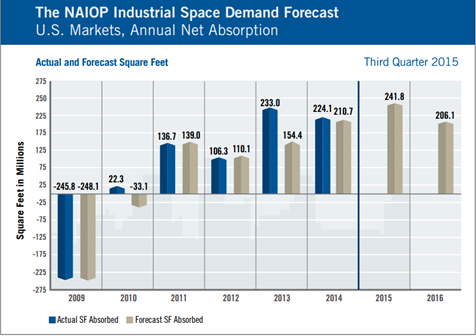
With talk about a frothy commercial real estate market, what trends do the retail and industrial sectors have to hold? According to a recent ICSC NOI+ conference held at the Dallas Hyatt Regency, a panel of leading investors and investor advisers imparted that retail real estate prices are plateauing and the number of bidders for available properties are down. It seems that the industrial market is taking a hint from the retail sector, as the NAIOP Research Foundation predicts a slowdown in industrial space demand for 2016 and beyond.

Retail Market Sees Prices Peak

Although it might seem gloomy, the current retail market talk is not necessarily foretelling an imminent industry downturn, even with some analysts equating current market conditions with those in 2007 the current situation is considerably more stable than the pre-bust period last decade, even with current pricing 20% to 30% higher, said Mark Gibson, Executive Managing Director of Dallas-based HFF. Commercial real estate continues to offer more secure returns than virtually any other investment, and investors are now viewing it as a long-term hold, Gibson said.

HFF cited data showing that commercial real estate investor allocations have improved from 9.5% to 13% in the past five years. Moreover, foreign capital investment in U.S. commercial real estate through the second quarter of 2015 had already surpassed all of 2014, Gibson added.

Given its stability, retail real estate offers the best access to inflation protection for investors than any other class, Glenn Lowenstein of Houston-based Lionstone Investments said. Investors are now looking toward opportunities in secondary markets, one panelist said, explaining that because prices are topping out in the 10 biggest U.S. metropolitan statistical areas (MSAs) such as New York, Los Angeles and Chicago, investors are gravitating to quality properties in the top 50 MSA’s.

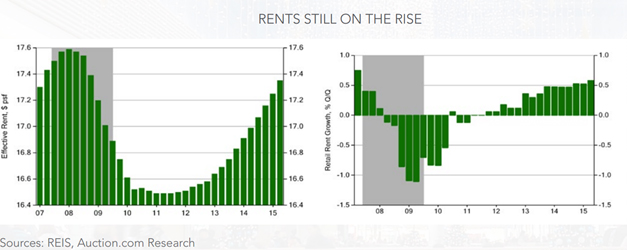
Rent growth is also up at retail properties, driven by lack of supply, panelists said.

rent-still-on-rise

Even with the supposed trust in commercial real estate investments, there are still legitimate concerns of excess liquidity and a fear that this will eventually create an asset bubble. The market is now seven years into the recovery — or about the time most cycles begin to play out, said Mark Myers, Executive Vice President and Head of Commercial Real Estate for Wells Fargo Bank of San Francisco. Overall, it would suite investors well to measure opportunities on a deal-by-deal basis.

Slowing Industrial Expansion

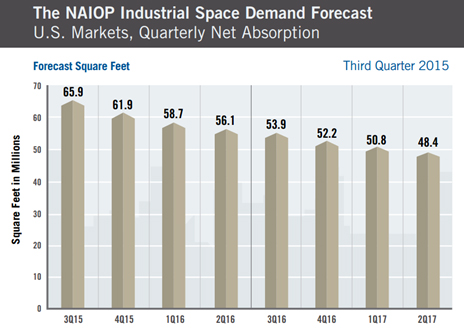
While the U.S. economy remains in slow, moderate growth and many economists cut their forecasts of GDP growth for 2015 and beyond, net industrial demand is still forecasted to remain positive, with over 60 million square feet of quarterly net absorption in the rest of 2015. However, the positive trend is set to begin its decline to rates below 50 million square feet quarterly by late 2016. Said to be impacting the domestic industrial space market, are declines in energy prices and the slowdown in the Chinese economy.

demand-forecast

Even though large economic factors are forecasted to have negative effects on the industrial market, there is predicted to still be a large source of new industrial demand going into 2017 from the manufacturing and distribution of consumer goods due to the U.S. employment’s state of steady growth. Consumer goods manufacturing and distribution has seen a steady expansion since the end of the recession, with major retailers such as Amazon and Wal-Mart competing to shorten the click-to-delivery time for online sales – which means more capital must be placed into industrial spaces.

What is yet to be seen is how interest rates will affect industrial demand. If the Fed moves its target short-term rate up by the end of 2015, the rising rate could moderate consumer spending and thereby reduce the demand for consumer goods manufacturing and distribution – meaning less need for industrial space.

industrial-space-demand-forecast 

Summary

Given the predictions for peaking retail prices and slowing industrial demand, commercial real estate professionals should utilize the data and forecasts to make more prudent decisions on capitalizing and embarking on new deals based on objective measures of future market conditions.

Sources:

ICSC Shopping Centers Today, Retail Real Estate Prices are Peaking, Conference Told, published October 22, 2015

NAIOP Research Foundation, The NAIOP Industrial Space Demand Forecast, Third Quarter 2015 Report

Thinking Outside of the Big-Box – New Retail Formats Emerge

While commercial real estate becomes increasingly scarce and expensive, urban populations continue to grow with millennials demanding more retail services. Challenged by local jurisdictions trying to curb sprawl, retailers are adapting to these economic, demographic and regulatory changes by moving away from their prototypical stores and developing smaller formats for in-fill locations.

Moreover, as internet retailers like Amazon have become adept at capturing sales from a broad demographic of consumers, the need for brick and mortar retailers to create a “shopping experience” has never been greater.  Apple was a pioneer in creating that shopping experience with its Apple Stores – and, as a result, more mall retailers are focusing on using their space to deepen brand identity and solidify positive connections with consumers.  Now, a number of national “big-box” retailers including Gap, Target, Petco, Best Buy, Office Depot, and Walmart are leading the pack in downsizing store footprints in order to bring the shopping experience to urban neighborhoods.

Target has recently adopted two new formats, dubbed “CityTarget” and “Target Express.” Both concepts offer smaller footprints than traditional Target stores – in San Francisco and downtown Los Angeles the stores range from 100,000 to 120,000 square feet, while the Target Express, which just opened its doors in the South Park neighborhood of San Diego on October 7th, is approximately 18,000 square feet. These small format shops aim to bring the convenience of their big-box counterparts to the modern urban dweller on the consumer’s terms.

The trend seems to be stretching even into established suburban areas as well. Wholesale giant Costco has started opening stores in regional malls where an existing department store has closed.  In these situations, Costco has demolished the existing department store and constructed its store in the same location, but on a single level and with an entrance into the mall.  In addition, other users such as theaters, hotels and even grocery stores have taken advantage of department store vacancies and mixed-use development opportunities within regional malls.

This trend will have broad reaching effects for urban consumers, local governments and CRE companies alike, providing consumers with more diverse shopping options closer to home.  Smaller, yet more numerous, retail outlets will allow local jurisdictions to diversify their tax base, and commercial real estate companies will be able to accommodate marquee tenants in locations that were previously too small for such retailers.

Smaller formats also create internal efficiencies for the retailers – who can rely heavily on their e-commerce operations as an alternative to carrying large inventories of products on-site – and offer a way for them to open more stores within the same trade area. Moreover, millennials are comfortable with a hybrid consumer approach whereby items ordered on-line are delivered to the store that is closest to the buyer’s home, thus allowing smaller formats to offer a wider selection of merchandise without the expensive overhead costs associated of maintaining large on-site inventories.

Sources:

CGS3-logoBy Craig Swanson, Crosbie Gliner Schiffman Southard & Swanson LLP (CGS3)

Craig Swanson, a partner at the San Diego-based commercial real estate law firm CGS3, recently helped negotiate the lease of the smaller format Target Express project in San Diego’s burgeoning South Park neighborhood.

2015 Investment Sales Snapshot: Retail, Office & Industrial Markets

Office and retail properties continue to be in high demand due to their high sale prices and low capitalization rates. While the industrial market has performed the poorest for number of transactions, sales volume, and price per square foot. Learn which property types to invest in Q4 2015.

As the 4th quarter approaches, we highlight investment sale activity across San Diego County and across the three major commercial property types of office, retail, and industrial.

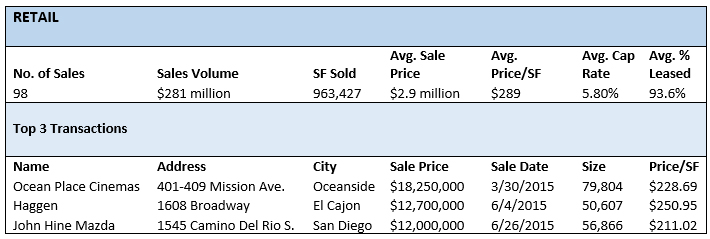
The following tables detail single-building investment sales in San Diego County in 2015 to date (Source: CoStar).

Of the three property types, the retail market had the highest number of transactions with 98 sales since January 2015. In addition, the average price per square foot was also highest for retail properties, and the average capitalization rate was the lowest at 5.80%.

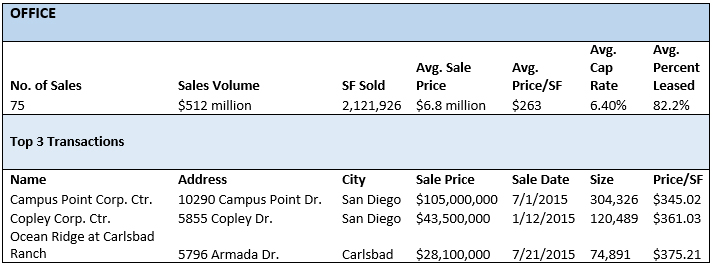
office-2015

The office market posted the highest sales volume with $512 million worth of property sold to date, with the average sale price of $6.8 million being the highest of the three property types. In terms of total square footage sold, the office market came in first with almost more than a million square feet sold than industrial, which came in at second out of the three property types.

The industrial market had the lowest number of investment transactions, lowest sales volume, and lowest average price per square foot. However, these results are to be expected due to the increased demand for both office and retail properties.

Summary

The highest single-building sales to date occurred in the office market, with sales ranging from $28,100,000 to $105,000,000. The retail and industrial property types each had their top three sales coming in under $20 million. Sales occurred throughout Central to North County, with no top sales occurring in South San Diego County.

As the data shows, office and retail properties continue to be in high demand, as evidenced by the high sale prices per square foot and low capitalization rates. Although fewer industrial investment sales have occurred, average capitalization rates are still below 7.0%, indicating that San Diego County commercial real estate investors will continue to demand this type of product.

Sources:

Case Study: What Do Triathlons and Commercial Real Estate Have in Common?

Brent Williams

Brent Williams

The answer is Meissner Jacquét’s newest Business Development Manager, Brent Williams.

Williams has had a notable career prior to joining Meissner Jacquét where he worked at several of San Diego’s commercial real estate industry’s leading firms including Cushman & Wakefield (then Cassidy Turley) specializing in investment sales and leasing in San Diego and Imperial Counties, and Wells Fargo Bank specializing in lending solutions.

During his tenure at Cushman & Wakefield, he earned Rookie of the Year, was named San Diego Power Broker of the Year, and successfully completed over 125 lease and sales transactions representing over $50 million in total value.

Most recently, Williams delivered lending solutions as part of Wells Fargo Bank’s Business Banking Group. Among his clients were commercial real estate owners and privately-held businesses across the nation, with a focus on Southern California markets, to whom he provided real estate financing, business lines of credit, equipment and practice financing.

The skills that Williams earned in commercial real estate brokerage and finance serve him well in his new role as Business Development Manager for Meissner Jacquét. His ability to provide clients with strategic solutions while focusing on increasing the clients’ overall value of their real estate portfolio, has not only earned him professional recognition but the ability to interact with many clientele types, including institutional property owners, financial institutions, commercial real estate developers, national, regional, and local investors, tenants, among others.

Williams’ drive to succeed not only awarded him with honorable mention in the San Diego Business Journal’s Emerging Generation: 25 in their 20’s, but continues to push him in his personal endeavors where he has successfully finished three Ironman Triathlons.

Brent holds a California Real Estate Sales License and membership in NAIOP Commercial Real Estate Development Association, International Council of Shopping Centers (ICSC), and Certified Commercial Investment Member (CCIM). If not found training for triathlons or rooting on his alma mater’s Wildcats in his spare time, Brent enjoys spending time with his wife, Kaley.

To contact Brent and learn more about Meissner Jacquét Commercial Real Estate Services, call him directly at 858-373-1113 or email him at brentw@sh4.7aa.myftpupload.com.

Sources:

Meissner Jacquét Commercial Real Estate Services

CRE Checklist for Performing Acquisition / Disposition Due Diligence

When it comes to commercial real estate acquisition and disposition due diligence analysis it helps to have a good checklist, and a good adviser. Navigating the sometimes murky waters of real property transactions can be complicated and risky when unprepared.

To arrive at a deal with favorable terms, both buyer and seller must perform a thorough and complete due diligence analysis, otherwise known as launching a thorough investigation to uncover all aspects of the real property to be conveyed. The information obtained from the results of the due diligence act to identify significant issues, and where possible, provide estimates of the financial impact such issues may have on the asset. Thereby better informing the buyer or seller and either confirming or denying the deal’s viability, or leveraging the ability to renegotiate.

Acquisition of Commercial Property

When a buyer makes an offer on a piece of commercial real estate, the offer is typically contingent on the buyer’s investigation of the property including the condition, the financial performance, title on record, interests in the property, etc. Due diligence is performed during the timeframe when the deposit is placed into escrow and the agreed upon close of escrow date.

Many times commercial real property transactions are completed on an “as-is” basis, which allows the seller to provide little to no warranties upon the close of the deal, and little to no recourse for the buyer once the sale is complete. Therefore the onus is on the buyer to perform their due diligence up front.

Disposition of Commercial Property

Many of the same standards that apply to due diligence performed in regards to the acquisition of commercial real estate, also apply to the disposition of commercial real property. Certain areas to address include, but are not limited to, the following:

  1. Independent appraisal of property value
  2. Environmental Report
  3. Recordable survey
  4. Legal description
  5. Location map
  6. Pictures of property
  7. Summary of property including:
    1. Size
    2. Description of physical improvements
    3. Any known easements, restrictions or reversions
    4. Current use

Financing Transactions of Commercial Real Estate

When a buyer is either looking to finance part or all of its purchase price for a piece of commercial real estate or a commercial property owner is refinancing to lower its interest rate, or due to a maturing loan, the lender will perform due diligence prior to providing financing. The buyer or property owner then has to provide all the necessary documentation regarding the property in order to facilitate the funding process.

Checklist for Performing Due Diligence

The main reason behind performing a due diligence analysis, whether in terms of an acquisition, disposition, or financing, is to arm the buyer, seller or financer with relevant information in regards to the suitability of the deal.

In addition to enlisting the assistance of a trusted adviser, the following basic checklist should be adhered to in order to ensure that the appropriate areas are investigated during the due diligence period, including, but not limited to:

Category Scope
Financial/Operations 1. Review schedule of existing vendor/service provider contracts.2. Review two prior years’ property tax bills.

3. Identify any transfer or excise taxes for which buyer may be liable.

4. Prepare Operating Budget.

5. Prepare Capital Budget.

6. Prepare Lease Abstracts, if applicable.

Physical/Structural 1. Commission new or updated physical review(s) of property by qualified consultant(s) to address areas including, but not limited to:· ADA

· Elevator Systems

· Fire/Life Safety Compliance

· Roof System

· Elevator Equipment

· HVAC Equipment

· Plumbing

· Parking Lot Asphalt

· Window Seal Water Proofing

· Other major building components.

2. If required by lender, commission new or updated Seismic/Probable Maximum Loss (PML) report by qualified structural engineer.

3. Perform property inspection and review all systems with building engineer, property manager, and/or qualified consultant(s).

4. Review history of property’s operating systems.

Environmental 1. Review environmental reports and, if necessary, commission new or updated Phase I/Environmental Site Assessment (ESA).2. Review draft reports and, if applicable, coordinate additional work as indicated (Phase II, Operation & Maintenance plans for asbestos, etc.).


Meissner Jacquét Commercial Real Estate Services has years of experience handling the acquisition and disposition of single projects, as well as complex, multi-project and portfolio transactions in major sectors of the commercial real estate industry, including office, retail, and industrial properties. Jerry Jacquét, a Principal at Meissner Jacquet, says that “we have developed the systems and relationships required to quickly and efficiently complete substantial transactions that are local, regional, and national in scope, as well as individual assets of any size.”

Meissner Jacquét’s commercial real estate acquisition and disposition services address the needs of each transaction, including land use, due diligence, environmental, joint ventures, and debt structuring. To learn more about Meissner Jacquét’s due diligence services and request a free proposal, contact Brent Williams at brentw@sh4.7aa.myftpupload.com or 858-373-1113.

Sources:

GlobeSt.com

Meissner Jacquét Commercial Real Estate Services

Case Study: Riding the Wave of Energy Management Systems

Property Name:                               Champions of the West Plaza

Property Location:                          12250 El Camino Real, San Diego, CA 92130

Property Description:                    Office, totaling 75,000 square feet

The owner of Champions of the West Plaza, a Class-A office building located in the highly sought-after submarket of Del Mar Heights, understands that buildings with a low Energy Star rating can drive away both tenants and potential investors. That’s why the property is equipped with an Energy Management System (EMS). An EMS is a suite of computerized tools that assist in the monitoring, controlling, and optimization of the performance of generation and transmission systems.

Client Requirements

When Meissner Jacquét Commercial Real Estate Services took over the property management services for Champions of the West Plaza in 2004, the building was ahead of its time, and its peers, with its Energy Management System (EMS). Ownership contracted with Meissner Jacquét and enlisted the building’s EMS into their oversight – with the ultimate goals of reducing energy consumption, improving the utilization of the system, increasing reliability, predicting electrical system performance, and optimizing energy usage to reduce costs.

Process

With the building’s EMS real-time data, the system’s applications are able to make system changes to maintain the power distribution systems and achieve scheduled values. In addition to providing the day-to-day property management services, Meissner Jacquét also oversees Genea, a supplier that provides cloud-based software and services for property managers, tenants, owners, and building engineers to manage tenant-related services including after-hours HVAC and lights, automated submeter reading and billing, building apps, and web portals.

Result

With the efficiencies found through Champion of the West Plaza’s EMS and Genea’s tools, the building is able to respond to customized tenant requests for after-hours HVAC and interior / exterior lighting demands. Ultimately, both ownership and tenants benefit from the EMS – ownership reduces its overall energy costs and tenants reduce their overall energy consumption. Meissner Jacquet is pleased to have the ability to continue to provide professional commercial property management services to the ownership and tenants of Champions of the West Plaza.

Sources:

Meissner Jacquét Commercial Real Estate Services

Do Green Buildings Receive More Rent?

Focusing on the effects of sustainability on commercial real estate, IRR San Diego reviewed leasing information to determine if green buildings, specifically LEED-certified or Energy Star, command a significantly greater rent than non-green buildings, i.e., those buildings without these certifications. Though it is difficult to quantify the impact on value for these types of properties due to limited data, the research focuses on asking rents for green buildings.

The U.S. Environmental Protection Agency provides the following definition for Green Building:

The practice of creating structures and using processes that are environmentally responsible and resource-efficient throughout a building’s life-cycle from siting to design, construction, operation, maintenance, renovation, and deconstruction. This practice expands and complements the classical building design concerns of economy, utility, durability, and comfort. Green building is also known as sustainable or high-performance building.

A green building generally has these six elements:

  • Site
  • Water efficiency
  • Energy efficiency
  • Indoor air quality
  • Materials
  • Operations and maintenance

Given the limited data, the findings were based on CoStar’s lease listings for existing, Class A office, specifically labeled with a LEED certification or Energy Star ration that were:

  • Built after 2000
  • Located in the city of San Diego, between approximately Highway 56 and Interstate 8
  • Over 50,000 square feet in size

The following table summarizes the results:

Green Building Non-Green Building % Difference
No. of Buildings 13 14
Rent Range/SF/Yr $31.20 – $51.00 $21.00 – $51.00
Average Rent/SF/Yr $41.35 $40.14 3%
Yr. Built 2001 – 2008 2000 – 2008


Based on a review of this data, there is a minimal difference in rent between green buildings and non-green buildings – while the lower rent range for non-green buildings is less than green buildings, there is only a 3% difference from the average rent.

In terms of ownership of a green building, factors that influence the value include the actual return the investor achieves, as well as energy efficiency.

While the limited study does not show a significant rental impact for a property having LEED Certification or an Energy Star rating, it does not mean that this type of value is not recognized in the marketplace by investors and tenants. Overall, an analysis of both income and expenses for a property is necessary in determining of value of going green.

Sources:

IRR – San Diego


Green is the Color of the Transportation Future

The latest mile marker on California’s road toward a clean air future came in the form of legislation encouraging the growth of the electric vehicle market.

Last year, Gov. Jerry Brown signed Assembly Bill 2565 – codified in California Civil Code Sections 1947.6 and 1952.7 – setting the stage for the continued development of electric vehicle infrastructure by permitting the addition of electric vehicle charging stations in commercial properties. California already accounts for 40 percent of all electric vehicles sold in the nation, so the impact of AB 2565 will reach across the state and across industries. Moreover, Brown wants California to put 1.5 million electric vehicles on the road by 2025.

With the rapid increase in the number of electric vehicles in the state and mounting pressure for commercial enterprises to be green, AB 2565 creates important new territory for commercial landlords – and their attorneys.

The law notably voids and makes unenforceable any provision in a lease for commercial property that prohibits or unreasonably restricts the installation of an electric vehicle charging station. It also provides a framework of rules governing the rights of tenants to install a charging station and their obligations regarding the operation, maintenance and removal of a charging station.

While there are some nuanced differences between Sections 1947.6 and 1952.7 regarding their specific applicability to commercial and residential real estate leases, there are relevant provisions of both statutes that may impact commercial properties such as office, retail, multifamily and industrial buildings. As a result, both commercial landlords and tenants should carefully consider the key provisions of the law early in the lease negotiation process:

Prohibitions to Charging Stations

Most importantly, any provision in a commercial lease signed, renewed or extended on or after Jan. 1, 2015, that either prohibits or unreasonably restricts the installation or use of a charging station is unenforceable. This prohibition does not apply to commercial properties with less than 50 parking spaces or which already have existing charging stations for tenant use at a ratio of 2 charging stations per 100 parking spaces.

Landlord Delay

Landlords may not willfully avoid or delay a tenant request for the installation of a charging station. In fact, landlords must approve a tenant’s written request to install a charging station so long as it complies with the Civil Code and the landlord’s reasonable procedures governing the making alterations to the property.

Locating the Charging Station

If the lease does not provide a tenant with a reserved parking space, and if the circumstances surrounding the installation of a charging station effectively provide the tenant with a reserved parking space, then the landlord may charge a reasonable monthly rent for that reserved space. But if an additional parking space is not available, then landlords are not obligated to provide a designated parking space to accommodate the installation of a charging station. Finally, a tenant does not have the right to install a charging station in more parking spaces than are allocated to the tenant under its lease.

Costs of the Charging Station

The tenant is responsible for all of the costs related to the design, installation, operation, maintenance and removal of a charging station (including reimbursing the landlord for the reasonable costs incurred by landlord in connection with the installation of the charging station, such as the cost of permits or supervision). These costs also include the obligation to pay the related electrical usage as additional rent.

Written Agreement

AB 2565 contemplates that the landlord and tenant will enter into a written agreement (presumably by way of an amendment with respect to leases in effect prior to the effective date of the statute) that incorporates, among other things, (a) the terms and conditions regarding the installation, operation, maintenance and removal of a charging station, (b) the tenant’s obligation to pay the costs associated with the installation, operation, maintenance and removal of a charging station, and (c) representation by the tenant that it is in compliance with applicable government requirements.

As landlords face a surge in tenant requests to install electric vehicle charging stations on their properties, alternative provisions must be incorporated into all legal forms regarding the charging stations. Such provisions and related agreements should be drafted in consultation with the landlord’s design, development, property management, and legal teams.

Plug-in vehicle sales currently represent about 3% of personal vehicle sales in California.

Electric cars and the infrastructure to support them are an important part of our transportation future. In fact, plug-in vehicle sales in California passed the 100,000 mark earlier this year, and currently represent about 3 percent of personal vehicle sales in the state.

With electric vehicle sales soaring, the National Renewable Energy Laboratory estimates that up to 1.2 million residential and workplace charging stations will be needed statewide by 2020. As the drive toward electric vehicles continues, attorneys – as well as tenants, landlords, property managers, and developers – need to stay abreast of the nuances and implications of this important new legislation.

Sources:

CGS3-logo

Sean W. Southard & Van Nguyen, CGS3


Sean W. Southard is a partner and Van Nguyen is an attorney with San Diego-based Crosbie Gliner Schiffman Southard & Swanson LLP – aka CGS3 – a law firm specializing in commercial real estate law.